The Uniqueness of Jesus Christ by Liam Lo
This edited transcript is from a talk given by Liam Lo in late March 2026 on NIU’s campus to InterVarsity students and staff. It includes solid evidence for Jesus Christ being Lord, and not just a good teacher or prophet. It also provides thoughtful reasons why Jesus had to be uniquely 100% Infinite God and 100% Sinless Man in order to make atonement for each person’s infinite sin debt to God. If you are not yet a believer, please take the time to read this with an open heart.
Opening Prayer
Heavenly Father, thank You, Lord, for bringing us here today to talk about the uniqueness of Your Son, Jesus Christ. Who is Jesus? Is He just a good teacher, or is He more than that?
As all of us here would profess today, He is way more than just a good teacher. He is a good teacher, but He is also Lord and God and Savior—Prophet, Priest, and King. We thank You that it is through His work of humiliation and exaltation that we have redemption, and through His blood, the forgiveness of sins.
As we talk about the uniqueness of Jesus today and His impact on history, help us to see that You are holy, Lord—that You are holy, set apart, undefiled, and worthy of all our praise and worship. In Jesus’ name we pray, Amen.
The Central Question:
Who Is Jesus?
I centered this talk around Matthew 16:13. The verse says, “Who do men say that I, the Son of Man, am?” I think this is the single most important question that we, not just as Christians but as human beings, have to answer. Who do we say that Jesus is?
The stakes could not be exaggerated on how important this question is, because here lies infinite life and infinite death. Not just because we might get the question wrong, but because in Jesus is the door—the pathway, the only way to free us from the wrath of God. Through faith in Him, we can have redemption and, by His blood, the forgiveness of sins.
So the stakes of this question are of infinite proportions. When we present Jesus, we are presenting this question to others. When we are doing the work of evangelism, we are presenting Jesus and trying to get people to make a decision about who He is.
Repentance is a change of mind about who our previous god was –we were all idolaters, serving various lusts and idols, but when we have repentance, that change of mind, we change our worship from the gods of this world to the true and living God in Jesus Christ.
Evangelism is therefore a very fearful and awesome thing. I want us to really grasp the weight of what we’re doing here today. It is a matter of infinite importance.
C. S. Lewis was famous for saying that Christianity, if false, is of no importance, and if true, is of infinite importance. The only thing it cannot be is moderately important.
Our Christianity cannot just be something relegated to Sunday worship or even Bible studies. It has to be all or nothing.
Jesus says, “He who is not with Me is against Me, and he who does not gather with Me scatters abroad.” We are on the right side of that verse today as we gather for Jesus’s kingdom.
The Uniqueness of Jesus: His Being (Ontology)
When we talk about the uniqueness of Jesus, He is the single most impactful figure in all of history. Who would challenge Jesus in influence on history?
Some might say Hitler, Muhammad, Joseph Smith, or Buddha. There are almost two billion followers of Islam today and hundreds of millions of Buddhists. But Jesus is unique not just in that He has the largest religious following in history. He is unique in several ways.
The first is that He is unique in His ontology. Ontology is the study of being. Jesus, in His being, is unique from every other being who dwelled on earth. He is uncreated in His God nature. As Christians, we believe that Jesus is truly God.
But He is also truly man. He is what theologians call hypostatically united to a human nature as well. So He is truly God and truly man. He is one of one in that instance. There is no other God-man in the history of the world. He had to be both to represent us and pay our infinite debt to God. No other man, even a perfect man, could do that for us. Only Jesus, because He is the incarnate God—God becoming man—He is utterly unique and worthy of our worship, devotion, and praise.

The Trilemma: Lord, Liar, or Lunatic
The application for evangelism here is the famous trilemma from C. S. Lewis.
What have you heard about Jesus? The popular conception is that Jesus is a good teacher.
The problem is that Jesus cannot be just a good teacher. A good teacher does not claim to be God if that claim is false.
If it were false and He did not know it, then He would be a lunatic. If you go to a mental hospital or meet someone on the street, you might find someone claiming to be God (Lewis).
But the difference between Jesus and those individuals is that Jesus had a higher standard of ethics than any other human in the history of the world. There was a Harvard ethics professor and author, Peter Kreeft, who once said something like if you were to boil down all the teachings of ethics in the past hundred years, it would not be a drop in the ocean compared to Jesus’s teaching in the Sermon on the Mount.
Jesus had an otherworldly standard of ethics that went deeper than outward actions and into inward intentions, down to the heart. And He lived that ethic out to the point of death. He literally died for what He believed.
If it was false and He did know it, then He would be a liar—not just any liar, but one on a scale the world has never seen before, deceiving billions of people.
But we know He was not a liar. No one dies for what they know is a lie. J. Warner Wallace, a former cold case detective, identified these three motives for crime: power, sex, and money. Jesus had none of these motivations.
Also another way that we can see that He wasn't a liar is that the effects of his teachings changed countless millions and billions of people's lives for the better. You know we have drug addicts turned sober. We have prostitutes regaining their dignity and we have people in the valley of the shadow of death coming to light a new hope. So His teachings themselves are evidence that he's not a liar as well.
So if He is not a lunatic and not a liar, then He is who He says He is—Lord and God (Lewis).
Jesus as Mediator and the “Divine Dilemma”
Jesus is also the perfect mediator between God and man. Man sinned against God, and we need atonement for our sins. But a finite man, however—even a perfect man—cannot atone for another man’s sins because they incur an infinite debt. So Jesus was not just a perfect man. Our Savior had to not just be a perfect man; He had to be truly God and truly man.
However, the human aspect is essential as well, because we were the ones who sinned against God, and we need a representative in our place who is of our likeness to represent us and mediate between us and God. Yet, like I said, He is truly God as well, which is so key because, being truly God, He has enough worth to redeem a countless multitude of sinners. And He can bear the infinite wrath of God and still survive afterward.
So there is no other mediator between God and man because there simply cannot be another mediator. Jesus is the one perfect answer to this riddle of what philosophers and theologians call the divine dilemma: how can God be truly good in a world where there is evil and suffering? In that sense, how can He be truly just and simultaneously merciful without obstructing either?
Because you see in Romans 3:26 that, because of Jesus’ redemption, God can be both the just and the justifier of the one who has faith in Christ Jesus. He is just because the wrath of God is being poured out on Christ on the cross, but He is also the justifier because we receive the benefits: His righteousness is accounted to us, and our sin is accounted to Him. There is no injustice happening there. On judgment day, there is not going to be any injustice—there is only going to be justice or mercy.
And the reason I cover this aspect as well is because the concept of Christmas and Easter is key to understanding why Christianity uniquely solves this divine dilemma of how God can be just and merciful. No other religious system can solve this dilemma. So we have a dilemma and a trilemma, and these two factors are going to be helpful as you’re having conversations about what makes Jesus uniquely fit to be the Savior of mankind.

The Roles of Jesus: Prophet, Priest, and King
Now next, we’re going to cover the unique role of Jesus. He is the mediator through His threefold office as a prophet, priest, and king. What is a prophet? Someone who speaks for God. Jesus is the prophet. He is not just a prophet; He is the final prophet. He is the one who speaks for God, but He is also uniquely the Word of God itself. He is the one who speaks for God and is the message of God. And He is the one that Moses predicted or prophesied about in Deuteronomy 18.
Next, He is also a priest for us. He is the Lamb of God who takes away the sins of the world, but He is also the great high priest who intercedes for us. And Jesus has already accomplished, once and for all, on the cross of Calvary, our redemption.
But what is the use of His present intercessory ministry? I think this is a key understanding to the comfort of Christians. Any ideas? Have you thought about Jesus’s intercessory ministry before? Because He is still a high priest for us. He always lives to make intercession for us, it says in Hebrews. He is able to save to the uttermost those who come to God by Him because He always lives to make intercession for us.
So what is the comfort of Jesus’s intercessory ministry, personally as Christians and also as we’re evangelizing? That’s kind of like a Theology 301 or 401 question.
I think the one key thing I want us to understand about Jesus’s intercessory ministry is that He is the bridge. He has accomplished, once and for all, our redemption on the cross. But His present intercessory ministry means that He is still praying. His ministry hasn’t finished yet; it hasn’t ceased. That doesn’t mean that His blood wasn’t sufficient, but what it means is that He is applying the benefits of what He has accomplished to us constantly, every day, moment by moment.
He is praying to the Father for our sanctification as Christians. One of the things Jesus says in John 6:44 is that no one comes to Me unless the Father draws him. So His present intercessory ministry, as we are doing evangelism, means that we are instruments in God’s hands in drawing His people to Himself.
So I want us to draw a lot of comfort from that as well. It’s not necessarily something you’re going to bring up in evangelism, but as people who are evangelizing, we can have the assurance that Jesus is praying for us and praying for the people we are evangelizing to, and His prayers are 100% effectual. We cannot possibly fail in the mission that He has set before us.
Jesus rules, and He is subduing us to Himself, our rebellious hearts, as our Lord and Savior. But He is also subduing our enemies as well through what He accomplished on the cross.
The Unmatched Influence of Jesus
Now let’s move on to the unique influence. This is really interesting. I believe that no one has touched the ant hill to Jesus’s Himalaya of influence on human history. Now, when you look at religious following alone, you could say Islam has a close second place. But when you look at actual influence on the world as a whole, Muhammad does not hold a candle to the noonday sun that is Jesus Christ.
Jesus’ Birth Split Human History into B.C. & A.D.
For one, you can look at the calendar year. Jesus was influential enough to essentially split time. If you talk to somebody and they ask, “Why would I want to talk about Jesus? What’s so important about Him?” you can say, “What year is it? Why is it that year?” That’s a good way to get the conversation started. If somebody was so influential that our entire calendar is based on His birth, shouldn’t we talk about Him?
We don’t really talk about Him in schools, and we don’t typically talk about Him in family conversations. The common saying in modern American families is “no politics and no religion at the dinner table.” So we want to show that this is objectively important. Even from a critical historical perspective, if a human being was this influential, we should talk about Him. He demands our research, our interest, and our respect.
Jesus’ Impact on Education
Jesus also had a massive impact on education. This is important to talk about today because many people have a certain view of Christians when it comes to education. Are they viewed as educated, or not?
One perspective is that Christians are less educated. Some people say that non-religious individuals are more likely to pursue higher degrees. Because of that, many view Christians as narrow-minded, unintelligent, or unwilling to engage with science or facts, as if they are holding onto a fantasy.
There’s also the argument that Christians tend to be more family-oriented and may prioritize work or family over extended academic paths, while more secular individuals may prioritize higher education, careers, and financial success.
It’s also worth noting that degrees are not the same as intelligence. That’s not a consistent measure. Often, these views reflect a bias against Christianity.
This perception—that Christianity equals being unintelligent—is common in modern America, but it hasn’t always been the case. For most of history, Christians have been at the forefront of education and many fields of study. Christians started many of the first universities, often with the purpose of training pastors and missionaries.
In fact, many of the world’s top universities were founded by Christians. Christianity has founded more universities than other religions, even when compared to religions that had centuries of head start. Christians have historically been at the forefront of education.
Jesus’ Impact on Science & Medical Care
The same is true for science. Christians started the first hospitals, demonstrating both scientific engagement and compassion for people. Hospitals as institutions did not exist in the same way before Christianity (Schmidt; Stark).
Additionally, many of the key figures in the scientific revolution were Christians. Across numerous scientific disciplines, there are hundreds of foundational contributors who were affiliated with Christianity in some way. Science as we know it developed in a Western Christian context for a reason. Christians believed that God is rational and created a world that can be understood (Hannam; Ferngren).
The reason to bring all this up is that you will encounter people with misconceptions about Christianity. It’s helpful to have some of these points ready. Another notable point is that a 65.4% percentage of Nobel Prize winners in the past century were Christians by affiliation. Even today, Christians continue to contribute significantly to the sciences (Shalev).
Jesus’ Impact on Art & Society
And lastly, we want to cover art—Jesus’s impact on art. The renowned masters of every historic period, every artistic genre, in every region of the world have painted, sculpted, sketched, or etched Jesus of Nazareth. This did not have to be the case, and it cannot be said of the leaders of any other religious movement. So Jesus has had a profound impact on art as well, wherever you look (Tavard; Begbie).
That covers the vast scope of His influence on society. And if you think about it, Jesus never traveled more than 200 miles from the place of His birth. He was born of peasants, never held a ruling position, and never wrote a book. How did He have this influence?
He has to be Lord. If it wasn’t supernatural, I don’t know what is—the sheer influence that He had.
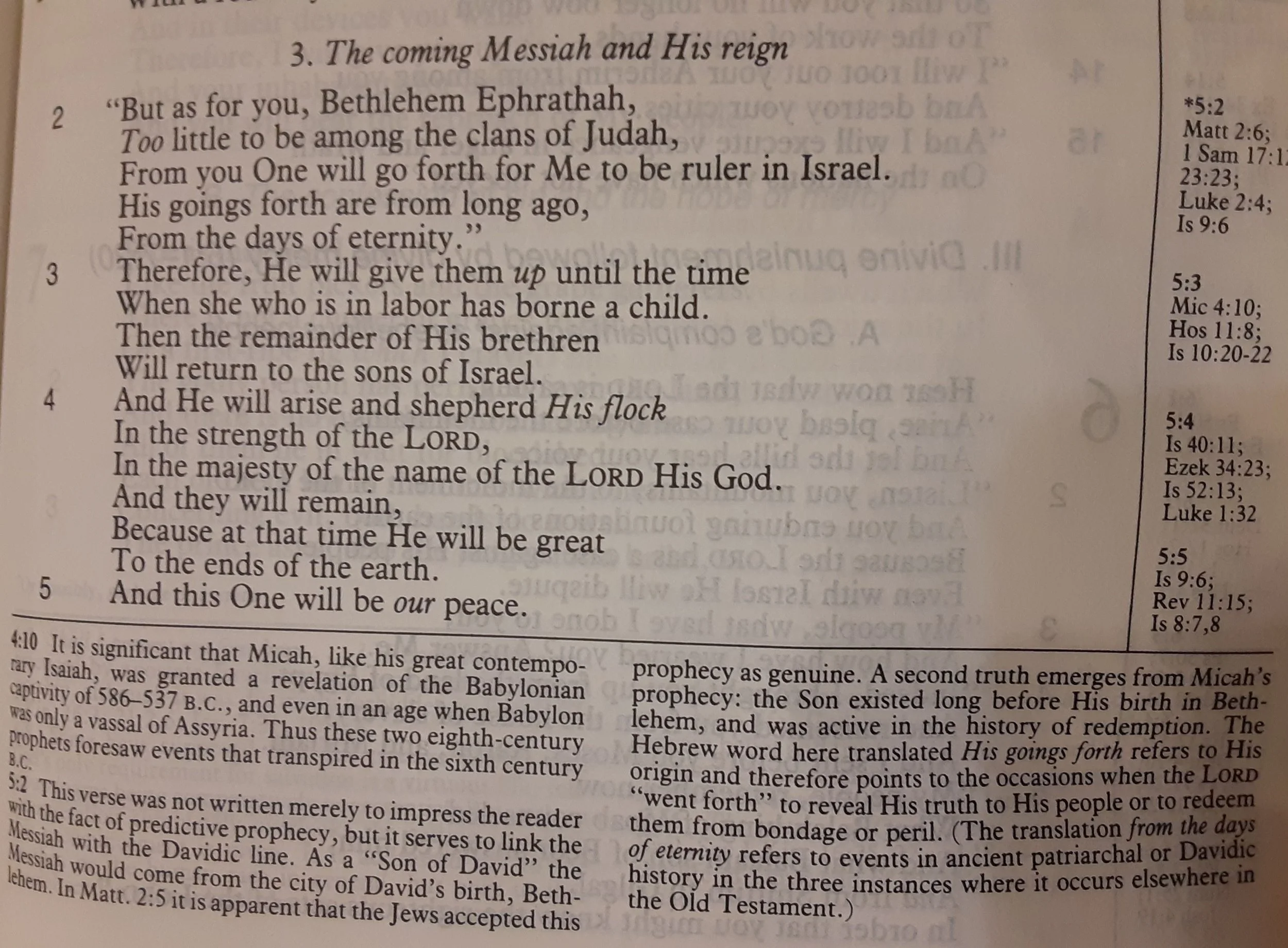
Micah 5:2-4
Prophecy: The Unique Foretelling of Jesus
Now next we want to look at the unique foretelling. Jesus is also unique in that He is the only predicted person in the history of the world. This is really useful in evangelism as well because prophecy is uniquely Christian in the sense that, while there are other claims of prophecy in other religions, when you look into them—like Nostradamus or others—they are very vague and ambiguous and can be interpreted in many different ways.
But if you look at Bible prophecy, specifically those about Jesus, they are very specific: the place He would be born, that He would be born of a virgin, and in Isaiah 53 it says He would die with the wicked and be buried with the rich. We know that Jesus was crucified with two thieves and was buried in a rich man’s tomb. It even includes details like being pierced and being sold for a specific amount—30 pieces of silver.
So, I want us to see the sheer statistical anomaly of Jesus fulfilling all these prophecies. Mathematics and astronomy professor Peter W. Stoner stated that the chances of just eight prophecies coming true by sheer chance is 1 in 10^17—that’s 17 zeros. That’s a number we can’t even really grasp (Stoner).
An illustration helps: it would be like covering the entire state of Texas with silver dollars two feet deep and expecting a blindfolded man to walk across the state and pick the one marked coin on the first try. Basically impossible.
Now, if you raise that from 8 to 48 prophecies, the probability becomes like filling the entire observable universe with electrons, marking one, and asking someone to pick that exact one on the first try. That’s just 48 prophecies. Jesus fulfilled around 300. The probabilities are astronomical.
One objection is that these prophecies were written after the fact. But we have two strong pieces of evidence against that: the Greek Septuagint, a translation of the Old Testament from around 250 BC, and the Dead Sea Scrolls, discovered in the 1950s, which contain nearly every Old Testament book. These include the prophecies about Jesus and were written hundreds of years before He was born.
So that objection doesn’t hold.
Historical Evidence and Corroboration
How do you respond when people say the New Testament authors fabricated details to fulfill prophecy?
I would say the accounts were written by independent authors to different audiences. Also, this goes back to the idea that people don’t die for something they know is a lie. We know from historical accounts that most of the apostles died for their faith. If they had fabricated these events, they would not have willingly died for them.
Also, their claims were falsifiable. Jesus lived and taught publicly. If these events were fabricated, eyewitnesses could have easily refuted them, and Christianity would have been discredited in the first century.
Now, the last point is unique corroboration—independent sources attesting to the claims of Christianity.
There are more non-Christian sources that attest to the existence of Jesus—92 of them—than Christian sources in the first four centuries, which number 51. From these non-Christian writings, you can reconstruct the major events of Jesus’s life, death, and even the claim of His resurrection.
It’s also a common myth today that Jesus wasn’t a real person. This is a helpful fact to bring up in conversation.
Finally, there are over 6,000 Greek manuscripts of the New Testament, with the earliest dating to within 50 to 100 years of Jesus’s life (Bruce; Metzger and Ehrman). To put that in perspective, consider Julius Caesar. Almost no one doubts his existence, yet we only have about 10 copies of accounts of his life, and those date to over 1,000 years after his lifetime (McDowell).
So, by the same standard, denying the existence of Jesus would mean denying all of ancient history.
The goal here is to show the overwhelming historical evidence for the existence, life, death, and resurrection of Jesus.
Conclusion and Encouragement
We’ve covered a lot, and I don’t expect you to remember everything. Evangelism is something we grow in over time. These points are tools in a toolbox. Many of them are not essential to remember, but at least remember the trilemma and the divine dilemma.
These facts are helpful tools to equip us to be better witnesses and to give a reason for the hope within us. My hope and prayer is that as we continue doing these workshops and outreach, we grow as evangelists. There’s no such thing as a perfect evangelist. You won’t say everything perfectly. But by the power of the Holy Spirit, as we go out prayerfully and prepared, we will make an impact.
We have Jesus’s promise that the gates of hell will not prevail. I’m encouraged by the turnout today. Thank you all for listening. Let me pray for us before we break out.
Closing Prayer
Heavenly Father, thank You for bringing us here today to talk about the uniqueness of Your Son. Help us to proclaim that He is the unique, only begotten Son of the Father, who came to bring us grace and truth, and that in Him we have redemption through His blood, the forgiveness of sins.
This is news better than any other news. This is news too good to be made up. Because of the greatness of this message, we want to share it with as many people as we can—strategically, gracefully, meekly, and effectively.
In Jesus’ name we pray, amen.
Evangelism is something we get better at over time. You do not have to be perfect. You will not say everything exactly the way you want to. But by the power of the Holy Spirit, as we go into it prayerfully and prepared, we will make an impact.
Jesus has promised that the gates of hell will not prevail.
I’m encouraged by the turnout today. Thank you all for listening.
©Liam Michael Lo
Used by Permission
Liam Lo is the owner of a healthy soft drink company, Drink Agape, and a para-church ministry, Truth More Glorious Than Fiction, where he seeks to promote reformation, revival, and unity through creating a network of churches and ministries to learn, worship, serve, and evangelize together.
Works Cited
Begbie, Jeremy S. Christianity and the Arts. Cambridge UP, 1991.
Bruce, F. F. The New Testament Documents: Are They Reliable? Eerdmans, 1981.
Ferngren, Gary B., editor. Science and Religion: A Historical Introduction. Johns Hopkins UP, 2002.
Hannam, James. The Genesis of Science: How the Christian Middle Ages Launched the Scientific Revolution. Regnery, 2011.
Kreeft, Peter. The Philosophy of Jesus. St. Augustine’s Press, 2007.
Lewis, C. S. Mere Christianity. HarperOne, 2001.
McDowell, Josh. Evidence That Demands a Verdict. Thomas Nelson, 1972.
McKnight, Scot. The Sermon on the Mount. Zondervan, 2013.
Metzger, Bruce M., and Bart D. Ehrman. The Text of the New Testament: Its Transmission, Corruption, and Restoration. Oxford UP, 2005.
Schmidt, Alvin J. How Christianity Changed the World. Zondervan, 2004.
Shalev, Baruch A. 100 Years of Nobel Prizes. Atlantic Publishers, 2003.
Stark, Rodney. The Rise of Christianity. HarperOne, 1997.
Stoner, Peter W. Science Speaks. Moody Press, 1963.
Strobel, Lee. The Case for Christ. Zondervan, 1998.
Tavard, George H. The Image of Christ: The Theology of Art. Eerdmans, 1998.
1. C. S. Lewis quote & trilemma
The quote and the “trilemma” (Liar, Lunatic, or Lord) come from Mere Christianity.
Mere Christianity
Lewis, C. S. Mere Christianity. HarperOne, 2001.
2. Key Source for the Claim
This quote is commonly attributed to Peter Kreeft, a philosophy professor (not strictly a Harvard professor, though he has taught at Boston College and written extensively on ethics and Christianity).
The Philosophy of Jesus
Kreeft, Peter. The Philosophy of Jesus. St. Augustine’s Press, 2007.
👉 Kreeft argues that the ethical teachings of Jesus—especially the Sermon on the Mount—surpass all other ethical systems in depth and influence.
3. Supporting Academic Source on the Sermon on the Mount
For a more academically grounded treatment of Jesus’s ethical teaching:
The Sermon on the Mount
McKnight, Scot. The Sermon on the Mount. Zondervan, 2013.
4. Jesus as more than a “good teacher”
Also grounded in Lewis and supported by historical Jesus scholarship:
Mere Christianity
Lewis, C. S. Mere Christianity. HarperOne, 2001.The Case for Christ
Strobel, Lee. The Case for Christ. Zondervan, 1998.
5. Christianity and the origin of hospitals
A widely cited historian on this topic:
How Christianity Changed the World
Schmidt, Alvin J. How Christianity Changed the World. Zondervan, 2004.The Rise of Christianity
Stark, Rodney. The Rise of Christianity. HarperOne, 1997.
6. Christians and the Scientific Revolution
Standard academic sources:
The Genesis of Science
Hannam, James. The Genesis of Science: How the Christian Middle Ages Launched the Scientific Revolution. Regnery, 2011.Science and Religion
Ferngren, Gary B., editor. Science and Religion: A Historical Introduction. Johns Hopkins UP, 2002.
7. Nobel Prize statistics and Christianity
Commonly cited compilation:
100 Years of Nobel Prizes
Shalev, Baruch A. 100 Years of Nobel Prizes. Atlantic Publishers, 2003.
(This is where the “majority of Nobel laureates were Christian-affiliated” claim is typically sourced.)
8. Jesus’s impact on art
Art history sources:
The Image of Christ
Tavard, George H. The Image of Christ: The Theology of Art. Eerdmans, 1998.Christianity and the Arts
Begbie, Jeremy S. Christianity and the Arts. Cambridge UP, 1991.
9. Prophecy probability (Peter W. Stoner)
This is the standard source for the probability calculations:
Science Speaks
Stoner, Peter W. Science Speaks. Moody Press, 1963.
10. New Testament manuscript evidence
Classic textual scholarship:
The New Testament Documents: Are They Reliable?
Bruce, F. F. The New Testament Documents: Are They Reliable? Eerdmans, 1981.The Text of the New Testament
Metzger, Bruce M., and Bart D. Ehrman. The Text of the New Testament: Its Transmission, Corruption, and Restoration. Oxford UP, 2005.
11. Comparison to Julius Caesar manuscripts
Often discussed in apologetics and textual criticism:
Evidence That Demands a Verdict
McDowell, Josh. Evidence That Demands a Verdict. Thomas Nelson, 1972.